
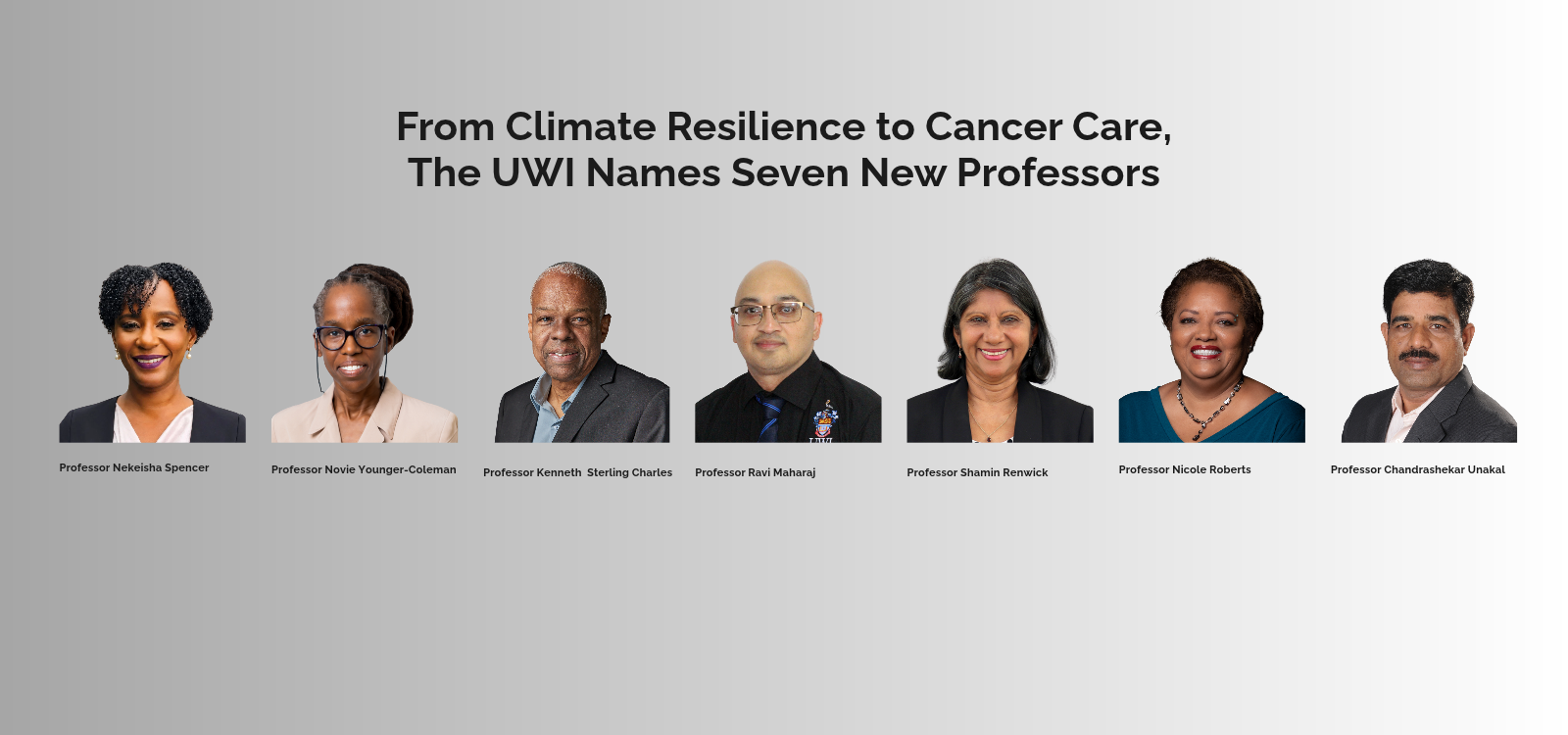
From Climate Resilience to Cancer Care, The UWI Names Seven New Professors

The UWI Regional Headquarters, Jamaica W.I. Friday, August 21, 2026—The University of the West Indies (The UWI) is pleased to announce its newest professors, who are among the region’s most outstanding experts in science, medicine and the humanities.
Their research and practice address some of the Caribbean’s most pressing challenges, including disaster risk and climate resilience, the rising burden of noncommunicable diseases, antimicrobial resistance and the need for improved diagnostic capacity in the fight against infectious diseases.
The scholarship of these highest ranking UWI academics focus on areas such as the security of the local blood supply, enhancing cancer care, training the next generation of Caribbean surgeons, improving information access for farmers and communities that have long been underserved by mainstream research and highlighting the literary and cultural life of the Hispanic Caribbean, ensuring that the Spanish-speaking Caribbean, along with its Black identities, is recognised as an integral part of the region’s narrative.
The seven scholars, whose appointments became effective on June 10, 2026, were promoted on the recommendation of internal and external assessors. After reviewing the quantity and quality of their research, publications, teaching and other professional activities, the assessors commended the scholars for carefully conducted research and high-impact regional and international work.
The new professors are:
- Professor Nekeisha Spencer (Mona Campus), professor of economics and the environment
- Professor Novie Younger-Coleman (Mona Campus), professor of biostatistics
- Professor Kenneth Sterling Charles (St. Augustine Campus), professor of haematology and blood transfusion
- Professor Ravi Maharaj (St. Augustine Campus), professor of oncological surgery
- Professor Shamin Renwick (St. Augustine Campus), professor of information literacy and management
- Professor Nicole Roberts (St. Augustine Campus), professor of Hispanic studies
- Professor Chandrashekhar Unakal (St. Augustine Campus), professor of medical microbiology
MORE ABOUT THE NEW PROFESSORS
Professor Nekeisha Spencer
For more than a decade, Professor Nekeisha Spencer has traced how climate change and extreme weather events, from hurricanes and tropical storms to heat and flooding, ripple through Caribbean life, affecting household consumption, crop production, banking, crime, migration, real estate, school performance, tourism, social welfare and labour markets. Her research applies rigorous econometric methods to some of the region’s most pressing development questions, spanning the late 19th- and early 20th-century Caribbean through to present-day disaster risk. These contributions have led assessors to recognise her as a leading scholar in environmental and natural resource economics, particularly in relation to the impacts of extreme weather events and climate change.
Formerly a senior lecturer in the Department of Economics at The UWI, Mona, Professor Spencer holds a PhD in economics and an MA in economics from Binghamton University, State University of New York, as well as an MSc in economics and a BSc in economics and statistics, both from The UWI, Mona. She has held scholarly appointments at the University of Oxford, the University of Birmingham and Aston University in the UK, and was an assistant professor at Albany State University in Georgia, USA, before returning to The UWI, Mona, as a lecturer in 2015.
Her publication record includes 25 peer-reviewed journal articles, one book chapter and one conference proceeding, as well as nine technical reports prepared for organisations including UNICEF, the World Bank and the Planning Institute of Jamaica. She has delivered more than 20 conference presentations regionally and internationally, and her research has received media coverage in The Jamaica Gleaner.
Professor Spencer serves as co-coordinator of the department’s Graduate Committee, where she has been PhD director since 2022. She has supervised and served on numerous MPhil/PhD and MSc committees and sits on the Editorial Board of International Journal of Disaster Risk Science.
Contributing significantly to international policy circles, Professor Spencer has been a member of the Working Group on Societal and Economic Research Applications since 2023 and served on the Steering Group of the Tropical Cyclone-Probabilistic Forecast Products Project until 2025 under the World Weather Research Programme of the World Meteorological Organization. She has also served as a member of the Technical Advisory Group of the Greater Caribbean Climate Mobility Initiative, a World Bank-UN collaboration, since 2023.
She was a keynote speaker at the UNDP’s Archipelagic and Island States Forum in 2021 and has served as a discussant and economics expert at workshops convened by the United Nations Economic Commission for Latin America and the Caribbean and the Inter-American Development Bank. Her honours include the Principal’s Research Award for Most Outstanding Researcher in the Faculty of Social Sciences for 2018-2019 and 2020-2021, and a Fulbright Scholarship through LASPAU from 2009 to 2011.
Professor Novie Younger-Coleman
Professor Novie Younger-Coleman has spent her career building the statistical foundation for some of Jamaica’s most significant public health research, from national surveys on diet, drug use and chronic disease to global collaborations tracking childhood growth and cardiovascular risk.
Assessors identify the Jamaican Health and Lifestyle Survey (JHLS) series as Jamaica’s foundational health-surveillance dataset. They commend her role as lead author of the 2022 JHLS Technical Report and as the central analyst across all three waves. One assessor noted that “Professor Younger-Coleman has effectively shaped what the country knows about its own NCD burden for two decades.”
Her expertise spans biostatistics, epidemiology and survey methodology, applied across studies ranging from local sickle-cell research to worldwide analyses published in The Lancet and Nature. Assessors commend her contributions to major international pooled analyses of NCDs, including the NCD Risk Factor Collaboration (NCD-RisC), which analyses blood-pressure trends across 19 million participants and diabetes trends across 4.4 million participants.
Further highlighting her contributions to global epidemiology, assessors note that Professor Younger-Coleman’s research addresses important and underrepresented areas, particularly health outcomes among Caribbean populations.
Prior to her promotion she was a senior lecturer in biostatistics at The UWI’s Caribbean Institute for Health Research since 2014. Professor Younger-Coleman holds a PhD in applied statistics from Nottingham Trent University (1998), an MSc in biometry (1995) and a diploma in statistics with distinction (1994), both from the University of Reading, and a BSc in agriculture from The UWI, St. Augustine (1991).
She was a postdoctoral fellow at the Medical University of South Carolina from 2001 to 2002, a visiting researcher at Loyola University Chicago in 2000 and at Lancaster University’s Department of Mathematics and Statistics from 2017 to 2018, and has lectured in medical statistics at The UWI, Mona, since 1999.
Her publication record includes 92 peer-reviewed journal articles, two book chapters and 11 technical reports for agencies including UNICEF, USAID and the Organization of American States. These global collaborations have generated citation counts in the thousands.
As coordinator of Mona’s PhD Epidemiology degree programme, she has supervised or co-supervised six PhD theses and more than a dozen MSc research projects. She has taught statistics across The UWI’s medical, nursing and public health programmes and has chaired or co-chaired the organising committee for the Biennial Jamaica Statistics Symposium across four cycles since 2013.
In recognition of her work, Professor Younger-Coleman has received the Principal’s Research Award for Best Research Publication in the Faculty of Medical Sciences (2018) and the Faculty of Science and Technology (2016), as well as the Award for the Research Project Attracting the Most Research Funds in the Faculty of Medical Sciences (2008).
She has led major grant-funded research, including a US$2.8 million NIH/NIMHD study extending Caribbean cohort data to inform U.S.-Caribbean comparisons on Black health disparities from 2018 to 2023, alongside multiple National Health Fund-supported national surveys.
She served as president of the Jamaica Statistical Society from 2016 to 2018 and was the International Biometric Society’s correspondent for the Central America and Caribbean region from 2009 to 2024.
Professor Kenneth Sterling Charles
Professor Kenneth Sterling Charles, a proud graduate of The UWI, has shaped the practice of haematology and blood transfusion medicine in Trinidad and Tobago across the clinic, the classroom and the national blood service he came to lead. As medical director of the National Blood Transfusion Service from 2005 to 2010 and, later, its consultant director from 2021 to 2023, he oversaw the restructuring of blood transfusion services nationally.
His PhD from Sheffield University, awarded in 2022, used historical, social, psychological and medical research to devise a model for voluntary, nonremunerated blood donation in a former colony. This work centred on The University of the West Indies Blood Donor Foundation (UWIBDF), which he established in 2011.
Professor Charles’ contributions to professional and regulatory life include his role as founding chairman of the Trinidad and Tobago Society for Haematology and Blood Transfusion. He has served as an elected member of the Council of the Medical Board of Trinidad and Tobago, including two terms as vice-president, from 2019 to 2020 and from 2022 to 2023, during which the Specialist Register for practising clinicians was implemented.
Formerly a senior lecturer in the Department of Pathology and Microbiology at The UWI, St. Augustine, where he served from 2011, and an honorary consultant haematologist at the Eric Williams Medical Sciences Complex, Professor Charles also holds fellowships from the Royal College of Physicians (2008) and the Royal College of Pathologists in haematology (2007). He also holds a Certificate of Specialist Training (CCST) in haematology from the Specialist Training Authority in the United Kingdom.
A committed mentor to the next generation of Caribbean leaders, Professor Charles has supervised more than 20 undergraduate and postgraduate research projects. His scholarship includes 32 peer-reviewed journal articles, one book chapter on ethical and health policy challenges in transfusion medicine in low- and middle-income countries, and nine technical reports based on national blood-bank data for Trinidad and Tobago’s Ministry of Health and the Pan American Health Organization.
Assessors note that Professor Charles’ work meets the highest investigative academic standards and demonstrates the value of integrating research with practical health-care-system implementation. They also highlight the progression from observational studies to intervention and policy-oriented work.
He is currently establishing local reference intervals for haematology parameters and working collaboratively to apply the UWIBDF model to increase blood donations from ethnic minorities in the United Kingdom.
Professor Charles’ teaching has been recognised by several undergraduate student organisations, including the Trinidad and Tobago Medical Students’ Association and the Movement for Empowerment of Dharmic Services, for outstanding lecturing. He established and coordinates the DM Haematology and Blood Banking programme, which trains haematologists and blood transfusion specialists for the region.
He represents the Caribbean internationally as a member of the Global Task Force of the Association for the Advancement of Blood and Biotherapies, the Global Haematology Special Interest Group of the British Society for Haematology and the Worldwide Network for Blood and Marrow Transplantation.
His advocacy for early clinical exposure, personal development, effective communication and community service has earned him advisory roles with several student organisations.
Professor Ravi Maharaj
In 2024, Professor of Oncological Surgery Ravi Maharaj made history in the English-speaking West Indies by authoring the region’s first surgery textbook. Spanning 41 chapters and more than 600 pages, the Textbook of Surgery for Medical Students features 106 contributing co-authors from Trinidad and Tobago, the wider Caribbean and across the globe.
The textbook is the capstone of a career spent training the next generation of Caribbean surgeons, alongside two decades of clinical practice in hepatopancreatobiliary and surgical oncology. Assessors agree that his career exemplifies the qualities of a dedicated scholar and clinician. They praise the clinical applicability of his research and its strong alignment with global priorities in surgical care and capacity-building.
Professor Maharaj has been head of the Department of Clinical Surgical Sciences at The UWI, St. Augustine, since 2021. He also served as coordinator of the DM Surgery postgraduate programme and currently serves as University Examiner Chair for the undergraduate MBBS Surgery exit examination across all UWI campuses. In this role, he introduced a continuous marking system and standardised clinical OSCE assessment.
He holds fellowships from the American College of Surgeons (2016), the Royal College of Surgeons of England (1999) and the Royal College of Surgeons of Ireland (1998). He completed a fellowship in surgical oncology at Tata Memorial Hospital in Mumbai in 2009, following an MBBS from The UWI in 1994.
In addition to the acclaimed surgery textbook, his publication record includes three book chapters and 70 peer-reviewed journal articles in high-impact publications such as British Journal of Surgery, Journal of the American College of Surgeons, Hernia and Journal of Women’s Health. His work has drawn more than 600 citations on Google Scholar, with an h-index of 14, and 203 citations on Scopus.
Professor Maharaj has supervised 10 postgraduate students through completion of their specialist surgical training. He was also central to the introduction of the DM Paediatric Surgery programme, the DM Plastic and Reconstructive Surgery programme and the Fellowship in Thoracic Surgery at The UWI.
Professor Maharaj’s contributions to national public health policy are noteworthy. He has served as national focal point person for colorectal cancer on the National Cancer Control Coordinating Committee since 2017 and as a member of the Caribbean Resource-Stratified Breast Cancer Guidelines team.
A former president of the Society of Surgeons of Trinidad and Tobago from 2007 to 2008, he currently serves as its honorary treasurer and as vice-president of the Caribbean Chapter of the Americas Hepatopancreatobiliary Association. His public education work includes multiple national television appearances and radio interviews on colorectal and breast cancer awareness.
Professor Ravi Maharaj established a benevolent fund to provide financial assistance to medical students experiencing hardship, reflecting his commitment to student welfare and equitable access to medical education. He regards this as one of his most meaningful achievements.
Professor Shamin Renwick
Professor of Information Literacy and Management, Shamin Renwick’s academic path bridges two distinct and rarely paired fields: agricultural science and library and information science.
Her doctoral research examined how food-security decision-makers in Trinidad and Tobago, Belize and Barbados seek and use information. The work grew out of a career spanning nearly four decades in Caribbean librarianship, from school libraries in the 1980s to her most recent post as acting campus librarian at The UWI, St. Augustine.
Assessors point to this focus as the source of her work’s originality. They note that her research centres on communities, including farmers and other agricultural workers, as well as the health behaviours of young adults that have been underrepresented and understudied within library and information science (LIS), giving her research what one assessor called “a unique and necessary perspective.”
Professor Renwick holds a PhD in agricultural extension (2017), an MPhil in agricultural extension (1992) and a BSc in agriculture (1984), all from The UWI, St. Augustine. She also holds a Master of Library and Information Studies (2003) and a postgraduate diploma in library science (1985) from The UWI, Mona.
She is a Fellow of the Chartered Institute of Library and Information Professionals in the UK (2007, revalidated in 2024). She has held senior library posts across the St. Augustine Campus and at St. George’s University in Grenada, where she served as director of library services from 2019 to 2020.
Her scholarship has drawn 457 citations and an h-index of 7 on Google Scholar. Her most-cited work, Knowledge and Use of Electronic Information Resources by Medical Sciences Faculty at The UWI, has been cited 203 times and recognised as highly accessed.
She co-edited Caribbean Libraries in the 21st Century (2007), which is held in more than 1,590 libraries worldwide according to WorldCat. She also served as section editor for Elsevier’s Encyclopedia of Libraries, Librarianship and Information Science from 2022 to 2024, coordinating 54 entries from an international pool of contributors.
Professor Renwick was appointed president of the Association of Caribbean University, Research and Institutional Libraries (ACURIL) for 2003-04, having risen through its Executive Council since 2000. She also served as president of the West Indies Group of University Teachers, St. Augustine (WIGUT), from 2015 to 2016.
Since 2018, Professor Renwick has mentored librarians internationally toward Chartered status with CILIP. Beginning in 2021, she has also advised the UK-based International Food Information Service.
Her contributions have been recognised with the Library Association of Trinidad and Tobago (LATT) Excellence Award (2024) for contribution to library and information services in Trinidad and Tobago, the ACURILEAN Star for Excellence in Research and Publication (2007), the ACURILEAN Medal for contribution to ACURIL (2005) and recognition as an Outstanding Graduate of the 1980s from The UWI, Mona’s Department of Library and Information Science (2012).
Professor Nicole Roberts
Professor Nicole Roberts’ work has a distinct connection to Puerto Rican writer Mayra Santos Febres, whose writings have anchored more than two decades of her research into race, gender and identity in Hispanic Caribbean literature.
From her earliest conference papers in the late 1990s through invited lectures in Cuba, Germany and the United States, and a personal interview with the author, this critical engagement has produced a substantial body of scholarship situating Puerto Rican and wider Hispanic Caribbean writing within Caribbean literary studies as a whole.
Professor Roberts was Director of the Centre for Language Learning at The UWI, St. Augustine, from 2023 until July 31, 2026. She holds a PhD in Hispanic studies from the University of Birmingham (1998), an MA in Spanish from Florida State University (1988) and a BA (Honours) in Spanish and French from Queen’s University, Canada (1985).
She joined The UWI in 1998 as a lecturer, was awarded tenure in 2004 and has twice served as head of the Department of Modern Languages and Linguistics, from 2012 to 2015 and from 2015 to 2018.
She has published the single-authored book Main Themes in Twentieth Century Afro Hispanic Poetry: A Literary Sociology (2009), six edited volumes, 15 peer-reviewed book chapters and 12 refereed-journal articles, alongside encyclopaedia entries and published translations.
Professor Roberts has supervised three completed PhD theses to graduation, four completed MPhil theses and 14 completed MA theses. She has delivered 60 conference papers and 11 invited lectures across the Caribbean, Europe and North America.
Assessors note her commitment to international conversations on topics related to Caribbean literature and the presence and representation of Blackness in the Spanish-speaking world. One assessor celebrates her as part of a legacy of women scholars in Caribbean academic institutions who have forged the field of gender and race studies.
Her recent co-edited volume, Innovation in Foreign Language Learning and Teaching: The Case of the Southern Caribbean (Palgrave Macmillan, 2023), extended her research into foreign-language pedagogy across the region.
Professor Roberts’ research has been supported by approximately TTD 1 million in funding, including five Campus Research and Publication Fund grants since 2002. In 2024, she was awarded a Jean Monnet Research and Publications Grant for a project on migration in Trinidad and Tobago.
She has served the University widely, including as deputy dean for distance and outreach in the Faculty of Humanities and Education from 2008 to 2010 and director of the Caribbean Interpreting and Translation Bureau from 2012 to 2018 and from 2019 to 2020.
Beyond the University, she has chaired St. Finbar’s Catholic Church’s Ministry for Migrants and Refugees since 2019 and serves on the editorial boards of Hispanic Journal and New Directions in the Humanities.
Professor Chandrashekhar Unakal
Medical microbiologist Professor Chandrashekhar Unakal has spent nearly two decades building a research programme focused on antimicrobial resistance, health care-associated infections and diagnostic innovation across the Caribbean. His work also includes his earlier research in Ethiopia and India.
His current work centres on the genomic surveillance of infectious agents in Trinidad and Tobago, as part of a broader global project supported by the Wellcome Sanger Institute and the Bill & Melinda Gates Foundation. This work complements ongoing studies into antimicrobial-resistant Gram-negative pathogens and the impact of pesticide exposure on the human gut microbiome.
Professor Unakal has been unit coordinator for pathology and microbiology since 2024, programme coordinator for the MSc, MPhil and PhD in medical microbiology since 2021, and programme coordinator for the DM Microbiology since 2025.
He holds a PhD in microbiology (2009), an MSc in microbiology (2005) and a BSc in microbiology (2002) from Karnatak University, Dharwad, India. Before joining The UWI, St. Augustine, in 2015, he held assistant and associate professor appointments under the United Nations Development Programme at the University of Gondar, Ethiopia.
Assessors have commended Professor Unakal’s consistent publication record in peer-reviewed international journals, his engagement in clinically and publicly relevant research, and his contributions across diverse geographical settings, including the Caribbean, Africa and India.
His publication record includes 46 refereed journal articles, 26 additional scholarly articles, seven book chapters and two patents granted by the Indian Patent Office: the Portable Nanoparticle Cytotoxicity Tester for Cancer Treatment and the Rogue Cell Removal Antimicrobial Bandage.
Professor Unakal’s work has drawn more than 3,000 Google Scholar citations. He currently supervises two PhD candidates and two MPhil candidates, has supervised more than 40 MSc research projects, and has delivered more than 30 conference papers regionally and internationally, including in Brazil, South Africa, the USA, India, Ethiopia and other Caribbean countries.
These contributions have earned him three Best Poster Presentation Awards, two Best Presentation Awards and the Early Career Research Award at national and regional conferences.
Professor Unakal’s contributions extend well beyond the laboratory. He has served as the American Society for Microbiology’s country ambassador to Trinidad and Tobago since January 2026. He is a member of the International Society for Infectious Diseases and a fellow member of the International Society for Biotechnology.
He has also served as president of the Caribbean Association of Clinical Microbiologists since 2023, having previously chaired its 17th Annual Symposium on antimicrobial resistance. He is a founding member and secretary of the West Indian Immunology Society.
Professor Unakal sits on the Trinidad and Tobago Ministry of Health’s Technical Working Group on Antimicrobial Resistance and the North Central Regional Health Authority’s Infection Prevention and Control Committee. He has also served as hall manager of the Joyce Gibson-Innis Hall since 2020.
His research collaborations with the Wellcome Sanger Institute in the UK, McMaster University in Canada and institutions in Ethiopia, India and the USA reflect a career built on sustained international partnerships in service of regional public health.
Related Posts
 by UWI TV
New York University honours Sir Hilary
 by UWI TV
The UWI and RSS Bring Global Expertise Together to Strengthen Caribbean Security Architecture
 by UWI TV